Event 1
Infant Tomb Looted and Right Arm Taken
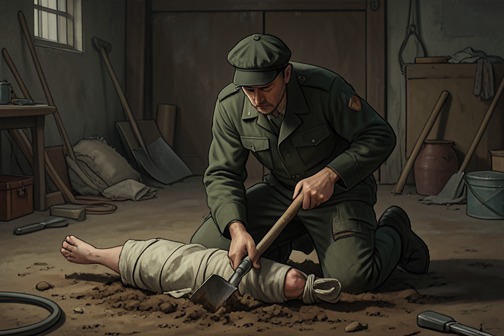
The [Infant Tomb Looted and Right Arm Taken](entity:event-recall-event-4e1081c5620e) is the clandestine excavation of a baby’s grave beneath a house in the [Baztán Valley](entity:location-recall-location-833f72e705c1). The removal of the infant’s right arm turns a hidden burial into a crime scene and supplies a material clue that will connect the grave to a family secret.
## The excavation
An unidentified person locates the grave by following the line that rainwater has drawn in the earth beneath the house’s eaves. Kneeling at the spot, the intruder takes a small garden shovel and pickaxe from beneath their clothes and chips through the compacted dark soil. The account slows over the work: the earth comes away in damp, soft clods, and the excavator removes it carefully, a few centimeters at a time, until fragments of blackened, rotting cloth emerge.
## The body and the missing arm
Working by hand, the excavator uncovered a blanket that crumbled at a touch and beneath it a body wrapped in waxed cloth. Almost nothing remained of the cord that had bound the bundle, though its pressure had left a deep mark in the fabric. The excavator felt for the edge of the wrapping, found its folded layers, and tore the shroud open.
The infant lay face down, as if cradled by the earth. Its bones and the cloth were well preserved, darkened by the soil of the Baztán Valley. The excavator pressed the tiny torso against the ground and wrenched off the right arm; the small clavicle broke with a faint crack. Startled, the excavator stepped back, then gathered the bones beneath their clothes, gave the grave one last look, and pushed the earth back into it with their feet. The burial was concealed again, but the missing arm made the desecration a source of evidence beyond the grave.
## The grave and the family secret
The later records make the buried infant legible as more than an anonymous victim, though they do not settle every circumstance of the child’s death. [Rosario Iturzaeta](entity:character-recall-character-rosario-iturzaeta-9b8b4d755062)’s obstetric file lists a natural twin birth in 1980: two apparently healthy girls, with no names recorded. A separate certificate identifies a newborn daughter of [Juan Salazar](entity:character-recall-character-juan-salazar-ca36cbfaa13c) and Rosario Iturzaeta and gives the cause of death as crib death. The distinction between the apparently healthy twins and the later death record leaves a gap that the paperwork does not explain.
That gap is widened by the family’s account. [Amaia Salazar](entity:character-recall-character-amaia-salazar-99849e02d251) says that her mother concealed the birth from the family, that neither she nor her sisters knew of the child, and that the birth certificate contained irregularities. Her relatives recall attending a burial, but the coffin was closed and they did not see the body. Amaia argues that the conflicting explanations of the death, the concealed birth, and the bones found in strange circumstances together make the newborn’s birth and death suspicious. The identification is therefore supported by converging records and testimony, while important details remain unresolved.
The infant’s age also gives the severed arm a particular cultural resonance. [Jonan Etxaide](entity:character-recall-character-jonan-etxaide-e04928c45e0f) explains that a mairu-beso was believed to derive its power from the remains of a child who died before baptism, and that the relevant child had to be a fetus, stillborn, or dead in the first months of life; an adult’s arm could not qualify. In folk belief, such a child’s spirit remained between worlds and might protect the family home. The grave’s infant remains thus connect the physical evidence to a belief about vulnerable dead children, without establishing that the belief itself explains the crime.
The arm also belongs to a wider criminal pattern. Amaia Salazar links the infant remains to the murders of Johana Márquez and [Lucía Aguirre](entity:character-recall-character-luc-a-aguirre-ccc11f981352), whose bodies had each been subjected to the same post-mortem amputation from the elbow, with the forearm missing. She notes that the detail in Johana’s case had been withheld from the press, while the Logroño murderer’s prison message matched another suspect’s in wording and unusual spelling. These correspondences lead her to suspect a single orchestrator whose intervention joins otherwise distinct killers and cases; the stolen arm is both a desecrated child’s remains and a clue to that concealed network.
## Historical memory and the meaning of the remains
The arm’s significance rests on a folk belief that made an infant’s death before baptism—not merely the child’s age—a condition of the mairu-beso’s supposed power. Jonan Etxaide explains that the remains had to belong to a fetus, a stillborn child, or an infant who died in the first months of life; an adult’s arm could not serve the same purpose. The belief placed the unbaptized child between worlds and sometimes cast its spirit as a guardian of the family home. That tradition gives the stolen arm a ritual meaning within the investigation, but does not prove why the grave was opened or who took it.
The investigation also sets the desecration against the history of the agotes, a people whose origins remain disputed. One account traces their arrival in Navarra to medieval flight from war, famine, plague, and religious persecution; other theories describe them as Cathars, deserters, or a mixed population of outcasts brought to serve a local feudal lord. For centuries they were confined largely to [Bozate](entity:location-recall-location-602b8eb2793d) and barred from living elsewhere, marrying outside their group, or running businesses. Their clothing had to carry an identifying mark, and they were made to ring a bell to announce their presence. Although they were Christians, church practice kept them apart: they had a separate baptismal font, were denied access to the altar, and in [Arizkun](entity:location-recall-location-arizkun-a4d48437b956) were separated from other worshippers by a railing and directed through a smaller door. The railing was later removed as a rejection of the shame attached to that treatment. This history supplies a setting of religious exclusion for the story’s concern with sacred places and marginalized dead, but the evidence does not establish that agote persecution caused the infant’s burial or its later desecration.
Event 2
Johana Márquez Murder
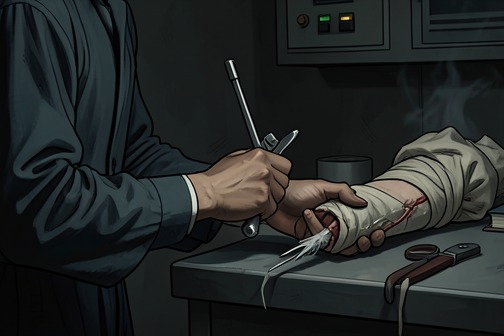
[Johana Márquez Murder](entity:event-recall-event-johana-m-rquez-e27d9d9d9104) becomes a pivotal case because [Jasón Medina](entity:character-recall-character-jas-n-medina-22d4966acd6a)’s confession seemed to settle responsibility for her death, yet evidence associated with the crime suggested that another person may have been involved. The distinction between Medina’s admitted actions and the unexplained features of the case opened a wider investigation into linked murders.
## Causes and Background
Johana was Medina’s stepdaughter. After he was arrested, he confessed to killing her and described trying to imitate a crime attributed to the Basajaun, which he had read about in the press. [Amaia Salazar](entity:character-recall-character-amaia-salazar-99849e02d251) regarded his responsibility for the murder as established, but the case did not end with his confession: investigators were also confronting evidence of an arm’s-length amputation and remains found at Arri Zahar, details that prompted [Teniente Padua](entity:character-recall-character-teniente-padua-8f73788d5a88) to seek her help in assessing possible connections.
## Evidence Linking the Cases
The comparison widened when investigators set Johana’s case beside the killing of [Lucía Aguirre](entity:character-recall-character-luc-a-aguirre-ccc11f981352) in Lekaroz a year earlier. Both victims had the same distinctive injury: a forearm had been removed at the elbow. The men convicted of their deaths also died by suicide, leaving messages that investigators judged strikingly similar. In the inquiry, those correspondences complicated the apparent finality of Medina’s confession and raised the possibility that the acts associated with the two cases did not all belong to the same offender.
The details of Medina’s confession sharpened that distinction. He had admitted killing Johana and said he later returned to obtain a rope so he could imitate a crime attributed to the Basajaun, as reported in the press. But he appeared unable to explain the missing arm: after he returned, Johana’s arm was already gone. Investigators also noted that the detailed information about the amputation had been withheld from the public, making an imitation based on press coverage less plausible. A forensic description characterized the removal as having been made with a toothed but sharp implement, such as an electric knife or jigsaw; investigators treated the repeated feature as a possible signature rather than simply part of Medina’s admitted conduct.
## The Unresolved Signature
The investigation also tested whether Medina fit the pattern investigators were assembling. Amaia Salazar noted that he lacked the aggressive or intensely frustrated profile associated with the other men under comparison. His wife’s suspicions had instead centered on his troubling attention to Johana and his increasingly close scrutiny of the girl’s schedule, outings, and clothing. Those observations explained why he had come under suspicion, but they did not account for the unexplained feature that distinguished the case.
The inquiry widened beyond Johana and Lucía Aguirre when investigators found two more women born in the [Baztán Valley](entity:location-recall-location-833f72e705c1) who had been killed by their partners. One had lived in Bilbao and the other in Burgos; notices for both had appeared at funeral homes in the valley. Their cases added a victim-based line of comparison, but the evidence presented them as leads for further investigation, not as proof that all the deaths shared a perpetrator.
The central uncertainty remained the apparent divide between Medina’s admitted crime and the repeated, unexplained signature. Investigators considered it unlikely that the detailed amputation method had been copied from press reports, since that information had been withheld from the public. They also questioned how an unplanned crime could coincide with the arrival of a figure they called Tarttalo, who took the trophy. The case therefore remained significant not only for what Medina confessed, but for the possibility that his confession described only part of what had happened.
## The Cell Inscriptions
The inscriptions supplied a more exact comparison than the general resemblance between the cases: the message left by the Logroño murderer was written on his cell wall in the same distinctive handwriting as the message left by Jasón Medina, and with an unusual spelling that doubled a letter where the common form used only one. Quiralte, meanwhile, had described scratching a nonsensical mark into the plaster with the handle of his toothbrush. Taken together, the wall writing and Medina’s note made the repeated wording look less like a detail borrowed from public reporting and more like a trace connecting separate crimes.
Event 3
Jasón Medina's Suicide at the Courthouse
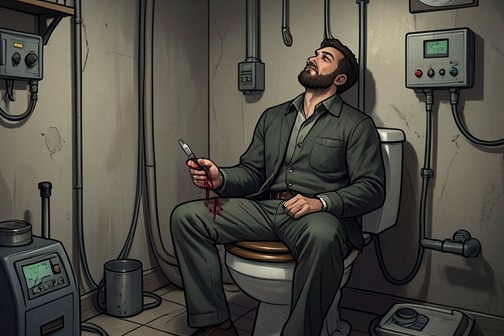
[Jasón Medina](entity:character-recall-character-jas-n-medina-22d4966acd6a)’s suicide at the courthouse abruptly halted the trial for the murder of Johana Márquez and turned an apparent act of self-destruction into a clue to a wider pattern of killings. Medina used a cutter that had been hidden for him, and the message found in his jacket connected his death to the name Tarttalo.
## The interrupted hearing
The hearing was about to begin when a uniformed police officer hurried into the courtroom, whispered to the secretary, and then spoke with the judge. After consulting the prosecutor and the defense, the judge suspended the session and left without explaining what had happened. Johana’s mother, dressed in mourning and visibly thinner than she had been at her daughter’s funeral, cried out for answers. Her distress sharpened the scene’s central contrast: the trial meant a formal reckoning for Medina, while the news from the courthouse cells had already made that reckoning impossible.
[Amaia Salazar](entity:character-recall-character-amaia-salazar-99849e02d251) was summoned downstairs by Lieutenant Padua. Outside the toilets, officers and a prison official stood pale and shaken. Blood was spreading from beneath the partition between the cubicles; inside, Medina sat on the toilet with his head tilted back and a deep cut across his throat. His shirtfront was soaked with blood. The guard had accompanied him to the bathroom and remained nearby, but, after hearing him cough, entered too late to stop the death.
The cutter had fallen from Medina’s hands into the neighboring toilet. Its presence raised an immediate security question: it was metal, yet it had passed into the courthouse. Padua showed Amaia that tape remained attached to its handle. The evidence suggested that someone else had placed the cutter in the cubicle, probably behind the cistern, where Medina could retrieve it. The suicide was therefore not simply a prisoner’s spontaneous act; the means had been prepared in advance.
## The message and its delayed meaning
The clue that changed the meaning of Medina’s death was not a conventional farewell. A white envelope had been taken from his jacket, and its sealed flap opened to reveal a card bearing a single word: Tarttalo. It was addressed to Amaia Salazar. The spare presentation made the word function less as an explanation than as a deliberate signal: Medina’s death had been arranged to deliver it to the investigator.
Months later, Lieutenant Padua revisited the suicide while discussing the investigation with Amaia. A photograph from Medina’s prison cell showed the same name scratched into the wall with the handle of a toothbrush. The prison director had described it as senseless graffiti, and the wall had since been painted over, but the marks remained visible. A closer examination with luminol revealed that Medina had written them in his own blood on the night before the trial.
The physical evidence made the act more deliberate still. Medina’s right index finger was badly eroded, with the nail gone and the skin worn raw, consistent with having been used to write against the wall. He had no toothbrush among his few belongings. The word in the cell and the card delivered at the courthouse thus formed two parts of a message: one left in the prison, the other carried out through a suicide timed for the day his trial was to begin.
Padua connected this pattern to a prisoner in Logroño who had also killed his wife, written the same name on a cell wall, and then died by suicide. In both cases, the spelling was distinctive: Tarttalo appeared with two t’s, although the common form used one. The repeated, unusual inscription made coincidence or casual imitation less persuasive and suggested a shared directing hand behind the separate murderers’ acts.
## The crime behind the signature
Medina’s suicide acquired a darker context when Amaia’s account of his interrogation was set beside the evidence about the murder. Medina had confessed to forcing Johana, strangling her with his bare hands, and violating her after her death. He cried throughout the questioning. Yet when asked why Johana’s arm had been cut off, he appeared genuinely perplexed and could not explain how it had happened.
His account placed the amputation outside the sequence of his own actions. After killing Johana impulsively, Medina returned home to fetch a rope, intending to imitate a crime attributed in the press to the basajaun. When he came back to the borda, Johana’s arm was already gone. He had also described feeling watched, and had wondered whether Johana’s ghost was following him. The account left a gap between the killing Medina admitted to and the removal of the limb he could not explain.
The injury was not an incidental detail. Johana’s arm had been amputated from the elbow with a toothed but sharp implement, compared by investigators to an electric carving knife or a jigsaw. In other reviewed cases, the same arm was removed after death and the missing limb was not recovered. Those acts stood apart from the familiar pattern of intimate-partner violence: the perpetrators were related to their victims, had histories of prolonged abuse, and often acted violently under the influence of alcohol or drugs, but the repeated postmortem amputation did not fit their individual crimes.
Amaia and Padua therefore considered the possibility that Medina had not been alone at the borda, despite the killing itself being impulsive. If Medina had made no plan, the appearance of Tarttalo at precisely the moment when a trophy could be taken required another explanation. The proposed one was that Tarttalo had already identified Medina as a murderer through expertise in reading criminal behavior and had followed him, ready to intervene when the opportunity arose. Medina’s unexplained sense of being watched thus echoed the case’s central distinction: he had committed the murder, but the severed arm and the name left behind pointed to a second actor.
## Investigation and institutional aftermath
The death did not end with the suspended hearing. About four months later, Lieutenant Padua told Amaia Salazar that the routine investigation had initially produced little to distinguish it from other custodial suicides. The exception came days afterward, when Luis Rodríguez, the prison official who had accompanied Jasón Medina to court, visited Padua in a distressed state and asked him to make clear that a third party had brought the cutter into the courthouse. Rodríguez feared being held responsible: Medina was the second prisoner under his custody to die by suicide.
The earlier case had occurred three years before, when a prisoner hanged himself in his cell overnight. The prison administration had acknowledged that it should have activated its suicide-prevention protocol by assigning him a cellmate. With another death now associated with Rodríguez, he worried about suspension or other sanctions. Padua reassured him, then asked about the earlier prisoner—a question that led him toward the matching wall inscription and brought the two suicides into the same investigation.
That retrospective inquiry changes the courthouse death from a closed episode into a link in a sequence. The official concern initially centered on custody and responsibility: how a metal cutter entered a guarded building, and whether a prison employee would be blamed. But the cutter’s preparation, the message addressed to Amaia, and the earlier prisoner’s matching inscription redirected attention from procedural failure toward an unseen organizer. The hearing’s abrupt suspension therefore marks both a personal and investigative interruption: Medina escaped judgment for Johana Márquez’s murder, while his death supplied the evidence that the case could not be understood as his crime alone.
Event 4
Logroño Wife-Murderer Dies by Suicide in Prison
The Logroño wife-murderer’s suicide in prison transformed an apparently closed domestic murder case into a crucial lead in the investigation of killings marked by a missing arm and the same distinctive message. His death, initially treated as an isolated prison incident, exposed a pattern that connected his crime to other murders.
## The suicide in prison
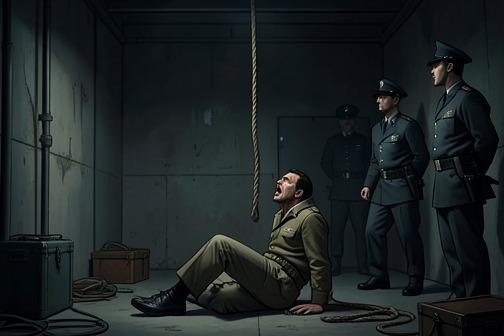
The man had been in prison only a few days when he died by hanging in his cell. He had shown no obvious warning signs: he was calm, eating well, sleeping soundly, and appeared to be adjusting to custody. Because he was new to the prison, he had spent several days alone in a cell and had received no visits from family or friends. One night, without any apparent indication of what he intended, he hanged himself.
The cell offered no high projection from which to suspend himself. He carried out the hanging seated on the floor, an act that required sustained effort. A prison officer heard him gasping and raised the alarm; the man was still alive when staff entered, but died before an ambulance arrived. The circumstances made the death more than a routine prison suicide: his apparent calm and the difficulty of what he had done suggested a deliberate, concealed purpose.
## The word on the wall
The prison director described the writing as something like a suicide note: the prisoner had scratched it into the plaster with the handle of his toothbrush. The wall had since been painted over, but the grooves remained visible in a photograph taken at an angle. They spelled one legible word: “TARTTALO.” Its exact spelling matched the message [Jasón Medina](entity:character-recall-character-jas-n-medina-22d4966acd6a) had left for [Amaia Salazar](entity:character-recall-character-amaia-salazar-99849e02d251), including an extra “t” that was unusual in the word’s common form. What looked like a senseless mark therefore became a link between two men who had killed separately and died in custody.
The comparison mattered because the Logroño wife-murderer’s violence was otherwise conspicuously different from the precise removal of the arm. He had stabbed his estranged wife, left a disorderly scene, and made no effort to conceal his own bloodied traces; the forearm, by contrast, had been removed after death, cleanly at the elbow, with little blood. Neither the severed limb nor the cutting tool was found. Amaia initially allowed that the amputation might have been incidental, but the matching inscription, repeated across cases, made the missing arm and the message look less like the work of each killer than the signature of another person.
That distinction also reshaped the reading of Medina’s crime. He had confessed to raping and strangling Johana Márquez, yet appeared genuinely perplexed when asked about her severed arm. He said that after killing her impulsively he had gone to fetch a rope, intending to imitate a crime he had read about; when he returned, the arm was gone. The timing suggested to the investigators that the person who removed the wife-murderer’s victim’s arm might likewise have acted alongside a killer without being the person who committed the murder. The suicide’s final word thus pointed beyond a resemblance between crimes toward a hidden operator who selected victims’ arms as trophies.
## The pattern and its unresolved limits
The connection between the Logroño death and the other murders had gone unnoticed partly because the cases were handled as separate, completed crimes. The killers had confessed, and in at least two cases had denied responsibility for the amputation; once they died by suicide, the files were readily closed. Information also remained divided among different police jurisdictions, while murders of women by their partners received little attention. The shame felt by victims’ families could deepen that silence. The matching detail that might have joined the cases—the removal of an arm—was therefore scattered across records rather than recognized as a shared clue.
The emerging pattern was not that the killers themselves all behaved alike. In the cases Amaia Salazar reviewed, perpetrators were generally relatives or partners of their victims, with histories of violence or violence held in check, often alongside alcoholism or drug use. Johana Márquez complicated that profile: she was the only victim living in the valley when she died, and her stepfather had no known history of violence. His sexual aggression and impulsive killing differed from the other perpetrators’ established pattern. The repeated sign across the cases thus pointed away from a simple likeness among the murderers and toward an additional actor whose intervention could leave the same trace in otherwise different crimes.
The investigation widened when two more women born in the valley were found to have died at the hands of their partners, one in Bilbao and the other in Burgos. Their deaths had appeared in funeral notices in the valley, but the available information did not establish whether either woman had suffered an amputation. They were possible leads, not confirmed additions to the series. The same caution applied to the theory that someone had selected or followed the killers: the investigators reasoned that the person behind the recurring signature might be skilled at recognizing violent men and recruiting them, and that he could have followed the unpredictable Jasón Medina to be present when Johana was killed. It remained an inference, but the prison inscription made the separate suicides part of the evidence rather than the end of the cases.
## How the earlier death resurfaced
The prison death returned to view during a separate inquiry into Jasón Medina’s suicide. Luis Rodríguez, the officer who had accompanied Medina to court, approached [Teniente Padua](entity:character-recall-character-teniente-padua-8f73788d5a88) worried that he might be held responsible for a second suicide among prisoners in his custody. Three years earlier, the Logroño wife-murderer had hanged himself in his cell; the prison administration had acknowledged that suicide-prevention procedures should have been activated by placing a companion with him. Rodríguez did not know whether the victim’s severed arm had ever been found. Padua’s questions about that earlier case brought the unexplained amputation into the investigation, turning a death previously treated as a closed matter into a route toward recognizing a wider pattern.
Event 5
Series of Desecrations at the Church of Saint John the Baptist in Arizkun
The [Series of Desecrations at the Church of Saint John the Baptist in Arizkun](entity:event-recall-event-50180a49ed1e) turns a run of apparent vandalism into a more disturbing investigation when an altar fire reveals a burned infant arm identified as a [Mairu-beso](entity:concept-recall-concept-mairu-beso-ea65b13695b8). The attacks damage objects central to worship, but the bones make the church itself a site where religious history, local memory, and folk belief converge. The investigation does not settle who is responsible or why; instead, it exposes competing explanations and the difficulty of separating a crime’s physical evidence from the meanings attached to it.
## The attacks and the discovery
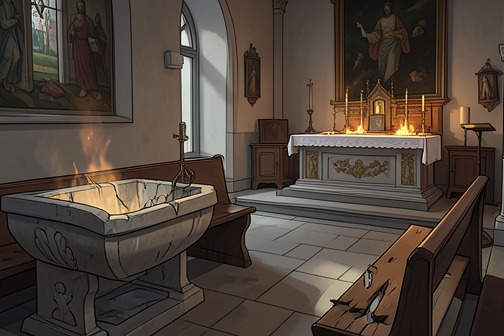
The sequence began at night when an intruder forced the sacristy door and split a baptismal font with a single blow. The font was an artwork more than four hundred years old. A week later, someone returned and hacked a front-row pew into splinters. Neither attack resembled ordinary theft: the perpetrators did not take money from the collection box or other valuables. The damage was directed at the church and its sacred furnishings.
The third attack brought fire into the sanctuary. An intruder used a torch to ignite the altar cloths; because they were linen, they burned slowly. A nearby chaplain, who had begun checking on the church after the earlier incidents, noticed lights inside and called emergency services. By the time a patrol arrived, the fire had gone out and the visitor or visitors had disappeared. The remaining signs of the small blaze made the latest intrusion look at first like another episode of desecration, but the object beneath a sheet at the altar changed the investigation’s stakes.
[Inspector Iriarte](entity:character-recall-character-inspector-iriarte-f7159785492e) uncovered what appeared to be dry, yellow bamboo reeds, one end burned. Doctor San Martín recognized the object as a Mairu-beso. When he lifted the sheet farther, it revealed broken reeds and the tiny bones forming a hand. [Amaia Salazar](entity:character-recall-character-amaia-salazar-99849e02d251) identified it as a child’s arm; San Martín clarified that it was skeletal remains, probably from a child less than a year old. Preliminary analyses later confirmed human remains belonging to a creature under one year old, without resolving the larger questions of identity or how the bones came to be there.
## What the Mairu-beso signifies
[Jonan Etxaide](entity:character-recall-character-jonan-etxaide-e04928c45e0f) agreed with San Martín’s identification and explained its traditional conditions: a Mairu-beso had to come from an infant who died unbaptized. According to the belief he described, such an arm could be carried like a torch for magical protection, while its smoke was thought to have a narcotic power capable of putting a household—or even a whole village—to sleep. The story thus attached a possible folkloric use to the very form of the burned object, though the account does not establish that the attackers acted from belief in those powers.
The distinction between the physical finding and its folkloric interpretation matters. The early analysis could establish that the bones were human and infant-sized; it could not establish baptismal status. Etxaide later explained why the tradition excluded adults: the supposed power depended not only on being unbaptized but on the age and condition of the dead child, who might have been a fetus, stillborn, or dead in the first months of life. In the belief as he recounted it, a newborn’s soul remained in transit between worlds. Unbaptized children were also said to remain connected to their parents’ homes as protective presences. Some families, he said, preserved a cradle, set a place at the table, or left food for the dead child. These customs make the arm more than a macabre instrument in the case’s cultural frame: it evokes both the vulnerability of a child denied burial within the usual religious order and a domestic practice of keeping the child present.
## A history of exclusion
The possible social meaning of the attacks rests partly on the history of the Agotes, a community associated with [Bozate](entity:location-recall-location-602b8eb2793d). Etxaide described their origins as disputed. Theories placed their arrival in Navarre across the Pyrenees amid medieval war, famine, plague, and religious persecution. One account identified them as Cathars persecuted by the [Spanish Inquisition](entity:organization-recall-organization-6c92825ae14b); others proposed deserters who contracted leprosy or a mixture of outcasts brought to serve the local feudal lord, Pedro de Ursua, whose palace-fortress survives in [Arizkun](entity:location-recall-location-arizkun-a4d48437b956). These possibilities were presented as competing historical explanations, not as a settled account.
What Etxaide emphasized was the long exclusion itself. For centuries, Agotes were prevented from leaving Bozate to live elsewhere, running businesses, or marrying outside their group. They were assigned work in woodcraft and leather, trades regarded as unhealthy, and required to wear identifying marks and ring a bell to announce their presence, as if they were lepers. They were Christians who observed Catholic rites, yet church practice marked them apart: they had a separate baptismal font, their holy water was discarded, and they could be barred from the altar and directed to a smaller entrance. In Arizkun, a grille once separated them from other worshippers; its removal registered the continuing shame attached to that treatment.
## Competing explanations and the investigation
At a meeting involving police and church authorities, [Padre Sarasola](entity:character-recall-character-padre-sarasola-eb88955119b2) recounted the attacks and argued that the human bones gave the case a particularly dangerous complexity. He suggested that the desecration might express hatred of the Church grounded in a misunderstood historical grievance, and asked that the matter be handled discreetly. Parishioners were already alarmed and, in his view, beginning to understand the attacks’ possible origins. Amaia Salazar was assigned to lead the investigation with her team because of her investigative abilities and knowledge of the area.
The police discussion did not turn that possibility into a conclusion. Amaia initially struggled to see why the attacks warranted such an unusual gathering when, beyond the damage to an old liturgical object, the case seemed to her like vandalism. She later organized the inquiry around the meaning and mechanics of desecration: an attack on a sacred place using human remains called for a profile more precise than the label vandalism alone. She initially favored vandalism, while keeping open the possibility of a socially motivated attack connected to Arizkun’s history. Art theft was considered a poor fit because such thieves typically studied their targets, avoided conspicuous damage, and took valuable objects rather than acting impulsively. The investigation therefore begins not with a confirmed motive but with a tension between senseless destruction and a pointed historical grievance.
## Significance
The sequence escalates through a set of objects: a baptismal font, a pew, altar linens, and finally the small bones beneath them. Each intrusion damages or violates a different part of the church, while the arm makes the conflict impossible to treat as property damage alone. Its interpretation links the present crime to a tradition about unbaptized infants and to the exclusion of the Agotes from religious life. Yet the evidence preserves a gap between those resonant histories and proof of the attackers’ intentions. The case’s force lies in that uncertainty: the church bears the visible injuries, while the infant remains raises questions of burial, belonging, and inherited shame that the investigation has not yet answered.
Event 6
Discovery of Lucía Aguirre's Body
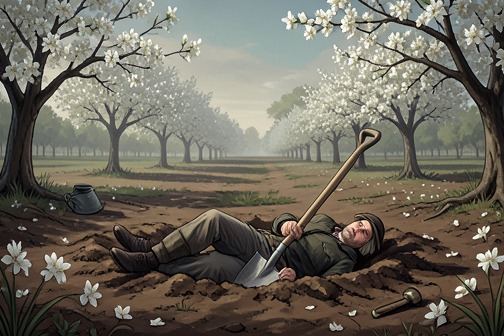
The discovery of [Lucía Aguirre](entity:character-recall-character-luc-a-aguirre-ccc11f981352)’s body began when Ramón Quiralte identified where he had buried her, turning a confession into a search for a grave—and a crucial scene of forensic evidence. In [Azanza](entity:location-recall-location-60524596938f), the excavation would expose not only the victim’s remains but also a clue connecting her death to a wider pattern of violence.
## The Coordinates and the Search
Quiralte described the chosen place through a memory of his father’s work making patxaran, a sloe-berry liqueur, near Azanza. After the harvest, employees could take berries left on the thorny blackthorn bushes. He said he had thought the brush would be the best place for her. When asked whether he had buried her there, he confirmed it, and [Judge Markina](entity:character-recall-character-judge-markina-f914c84921ae) ordered him to accompany the investigators and show them the location.
Rather than draw a map, Quiralte wrote a short sequence of numbers and letters: coordinates. [Amaia Salazar](entity:character-recall-character-amaia-salazar-99849e02d251) recognized them as longitude and latitude. The team traced them to a plantation near Azanza, a small town in the Estella district whose principal industry was patxaran production. By the time the investigators had gathered and found the indicated spot, dusk was falling. Small white blossoms covered the trees, making the plantation resemble a corridor more than an improvised cemetery.
Amaia had insisted on bringing a canopy despite the rush. Although rain was not expected, she wanted to prevent any precipitation from compromising possible evidence around the grave. As technicians set up lights and began to dig, the fading daylight and the carefully protected site marked the transition from Quiralte’s account to the physical examination of the burial.
## The Grave Opened
The excavation first yielded a black plastic wrapping. When the bundle was exposed, the team saw that the body had been enclosed in two large garbage bags, one over the head and the other over the feet, joined around the woman’s waist with paper tape. The tape had come loose; stirred by a light breeze, it fluttered as if the body were moving beneath the earth. A stronger gust exposed the victim’s red-and-white sweater. Amaia Salazar recognized it from a dream, and the recognition sent a shiver through her.
She ordered photographs from every angle. While the photographers worked, she stepped back, crossed herself, and bowed her head to pray for the victim. Then, absorbed by what she was seeing, she asked Doctor San Martín to cut farther into the wrapping. He opened it down to the knees, allowing Amaia to examine the body more closely.
With the corpse lying on its side, the right arm was partly hidden beneath it. Amaia knelt beside the grave, felt along the shoulder and forearm, then carefully reached beneath the body at the biceps and drew the arm into view. It had been amputated at the elbow in a straight, assured cut. There was no blood; the rounded bone and dry tissue around it were visible. [Jonan Etxaide](entity:character-recall-character-jonan-etxaide-e04928c45e0f), holding the plastic, lost his balance and landed on the ground as the arm was uncovered.
The sight abruptly overwhelmed Amaia. She recoiled, then, at Jonan’s prompting, returned to the immediate demands of the investigation: she ordered him to leave with her, stripped off her gloves, and ran toward the car. Before going, she turned to Judge Markina and instructed him to have Ramón Quiralte kept under exhaustive surveillance in prison, with someone assigned to watch him if necessary. The burial had now yielded more than the location of Lucía Aguirre’s remains: the severed arm made the grave a possible link to another killing.
## Forensic Comparisons and Wider Implications
The arm’s clean edge prompted a forensic comparison with the mutilation in the Johana Márquez case. Doctor San Martín determined that the cut on Lucía Aguirre had been made after death, when the heart had stopped and the blood had begun to coagulate. The toothed mark suggested a powered cutting tool: perhaps an electric wood saw, though the pattern also brought an electric knife or grinder to mind. In the earlier case, investigators had assumed that Johana Márquez’s father was responsible and had compared tools from his home and car without finding a match; the object used to amputate her arm had not been investigated further. The resemblance between the injuries reopened a line of inquiry that the first investigation had left incomplete.
The comparison remained suggestive rather than conclusive. San Martín found that the cuts shown in the available photographs shared a technique and appeared to have been made by a right-handed person with comparable force and confidence. But photographs of stripped bones could not establish the victims’ ages or sexes, date the bones reliably, or determine whether an arm had been surgically removed or taken in a desecration. All the visible bones were adult forearms, yet a definitive comparison required the physical samples: investigators could make casts, scan the cuts, and superimpose the results. The [Guardia Civil](entity:organization-recall-organization-guardia-civil-268ba482c33f) held the relevant remains, and the limits on sharing evidence left the comparison short of proof.
A later material analysis supplied a different kind of connection. Doctor San Martín reported that an antique scalpel sent from the Estella sanatorium dated to the seventeenth century, based on its metal alloys and the method used to cast and forge it. The metal tooth embedded in Lucía Aguirre’s bone had the same alloy and forging. That match tied a feature of her remains to an identifiable historical instrument, while also sharpening the distinction between what the evidence established—the shared metalwork—and what it did not, by itself, establish about how the weapon had reached the scene or who had used it.
## A Separate Bone Trail
The resemblance between Lucía Aguirre’s severed arm and the cuts in the Johana Márquez case entered a wider investigation already shaped by another, markedly different bone discovery. Testing of an arm bone found at the [Arizkun Church](entity:location-recall-location-arizkun-3cb762efd8fa) showed that it belonged to a newborn—approximately nine months before birth or one month after it—and was about 150 years old, with an estimated margin of error of five years. Unlike the adult forearm recovered from Lucía’s grave, this fragment had been burned at one end and belonged to a much older burial context; its significance could not be inferred from resemblance alone.
The infant bone’s DNA nevertheless produced an unexpected present-day connection: it showed a 25 percent match with Amaia Salazar. That result redirected the investigation toward Amaia’s family history, where an obstetric record listed a twin birth in 1980 and a death certificate recorded a newborn daughter of [Juan Salazar](entity:character-recall-character-juan-salazar-ca36cbfaa13c) and [Rosario Iturzaeta](entity:character-recall-character-rosario-iturzaeta-9b8b4d755062) as having died of “crib death.” Relatives had not known that the child was born, and the closed coffin meant they had not seen the body. These disclosures did not establish that the infant remains and Lucía’s murder shared a perpetrator or cause; they showed instead how the investigation’s recurring evidence of severed arms could open distinct lines of inquiry, one into a modern killing and another into a concealed family loss.
Event 7
Ramón Quiralte's Suicide in Prison
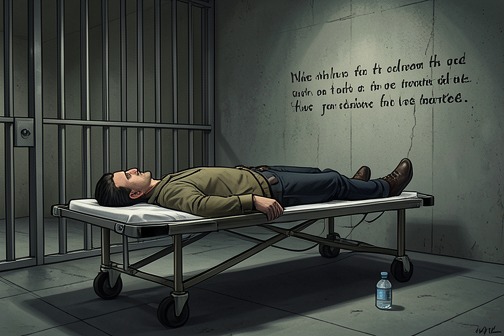
Ramón Quiralte’s suicide in prison turns a suspected pattern of intimate-partner killings into a more disturbing investigation: Quiralte dies after poisoning himself, but the word he leaves behind points beyond his own crime.
## The poisoning and death
Before entering the prison, [Amaia Salazar](entity:character-recall-character-amaia-salazar-99849e02d251) had asked the judge to keep Quiralte under close surveillance. She and [Jonan Etxaide](entity:character-recall-character-jonan-etxaide-e04928c45e0f) hurried back after learning that Quiralte had swallowed poison and was unconscious amid vomit and blood. By the time Amaia reached his cell, he lay intubated and motionless on a stretcher. The prison doctor explained that Quiralte had mixed his dose in a cyclist’s water bottle and taken it soon after arriving in the cell. The corrosive poison had caused severe burns around his nose and mouth. Although the medical team had responded quickly, they had been unable to save him; the doctor described the self-inflicted poisoning as an especially agonizing death.
## The message in the cell
The cell contained a second message alongside the evidence of Quiralte’s death. On the wall of the lower bunk, he had written TARTTALO. Amaia had to bend to see it; Jonan followed her gaze and noticed the substance before the prison doctor confirmed that Quiralte had written the word in feces. The doctor described writing with filth as a common form of protest in prison, but could not explain what this particular word meant.
The inscription turns the suicide from a closed act of violence into a possible communication. Quiralte leaves no note that explains his purpose; instead, the word is both conspicuous and opaque, carrying a meaning the prison staff cannot read. Its material matters too: a familiar prison protest practice becomes the medium for a name—or a sign—whose significance exceeds the cell.
That word had already appeared in another prisoner’s cell. Earlier, a director had reported that a man scratched an apparently senseless mark into plaster with the handle of his toothbrush. Though the wall had been painted over, the grooves remained legible in a photograph: TARTTALO. The recurrence links the two deaths through a distinctive written trace, while leaving open who authored or transmitted it and what the term signifies. Quiralte’s final message therefore supplies no simple confession; it deepens the investigation by making the same unexplained mark appear where another killer died.
## The pattern behind the inscription
The word in Quiralte’s cell gained investigative weight because it had appeared in another prisoner’s cell, in the same unusual spelling and handwriting. Amaia Salazar noted that the common form used one “t,” whereas both inscriptions used two. By then she had identified three cases and suspected there might be more. The mark suggested that the deaths were connected, but the repeated spelling alone did not explain who had made it or how the cases were linked.
The missing arm supplied a second, more disturbing point of comparison. In each case, a victim’s arm had been amputated after death, and the limb was never recovered. At first, Amaia treated the mutilation in Quiralte’s case as possibly incidental: perhaps the killer had removed a hand to take a wedding ring or frustrate identification, though neither explanation made much sense in the victim’s own home. The comparison with other murders changed its significance. The amputation was not simply part of the killers’ violence; its recurrence, including the removal of the same arm, suggested a distinctive signature.
[Jasón Medina](entity:character-recall-character-jas-n-medina-22d4966acd6a)’s confession sharpened the distinction between the individual killer and the person behind that signature. Medina admitted that he had raped Johana Márquez, strangled her with his bare hands, and sexually assaulted her after death. But when questioned about the missing arm, he was bewildered and did not know how it had been removed. He had left to fetch a rope so he could imitate a murder he had read about; when he returned, Johana’s arm was already gone. Amaia remembered him crying through the interrogation, his face streaming with tears and mucus, and regarded his confusion about the amputation as genuine.
That sequence made the repeated mutilation difficult to attribute to spontaneous imitation. Medina’s violence was impulsive, and the arm had disappeared while he was away, yet the person investigators called the Tarttalo had been present at precisely the right moment to take it. Amaia and her colleagues inferred that the unknown figure had already known Medina and was following him. The inference reframed the cases: the intimate abusers’ murders and the recurring removal of an arm might belong to different stages of a crime, with the second act imposed by someone who could identify and track killers. Quiralte’s death thus left investigators with a sign that connected the cases, while the larger pattern pointed toward an unseen operator.
## The confession’s boundary
Quiralte had been found close by, drunk and still stained with his wife’s blood. He confessed to killing her immediately, but denied any part in the amputation. The cut ran from the elbow and had been made with something toothed yet knife-sharp, such as an electric carving knife or jigsaw. That detail made the severing look like a separate act from the killing he admitted to: the confession established his responsibility for the murder, but left the missing arm unexplained.
Amaia initially considered whether the hand had been taken for a wedding ring or to prevent identification, while doubting that either explanation made sense in the victim’s own home. Quiralte’s later death closed off the possibility of questioning him further. The suicide therefore leaves a double limit on what his confession can establish: he acknowledged the intimate violence, yet the recurring removal of an arm and the inscription in his cell point to a dimension of the crimes his admission did not resolve.
Event 8
Ibai's Birth
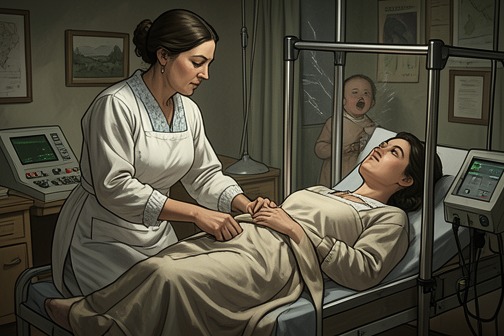
[Ibai](entity:character-recall-character-ibai-8322a92bd103)'s birth is a scene of bodily ordeal, startling reversal, and sudden joy: [Amaia Salazar](entity:character-recall-character-amaia-salazar-99849e02d251) gives birth while struggling to return her attention to the delivery room, then learns that the child she and [James](entity:character-recall-character-james-b40e84036a54) expected to be a girl is a boy. The name she gives him, Ibai, means river, carrying into the child's arrival the river that has filled her mind during labor.
## Labor and the Voices
The midwife calls Amaia back to the present and tells her that the birth is ready to happen. Amaia, however, is still hearing other voices over the midwife's instructions. They demand that she cleanse the river and the valley and wash away an offense; their cries merge with the cry that rises from Amaia as another contraction takes hold. Her brief refusal does not stop them, and the scene sets two forms of urgency against one another: the immediate physical work of childbirth and the insistent voices that occupy her attention.
The midwife makes the next task concrete. Amaia must push with the next contraction, she explains, and the labor could take two contractions or ten depending on how effectively Amaia works. Amaia nods, sits up, and grips the bars. James positions himself behind her, supporting her silently. His face is pale and bewildered, but he remains steady; the midwife's practical focus and James's physical presence give Amaia support while she is still contending with the voices in her head.
## The Effort of Birth
As the contraction comes, the midwife urges Amaia to push. Amaia commits all her strength to the effort, holding her breath and bearing down until she feels something inside her break. Once the contraction passes, the midwife tells her she has done well, but instructs her to breathe for herself and the baby before the next one. The exchange keeps the birth grounded in its physical demands: Amaia's effort matters, but so does the instruction to pace that effort and breathe.
The choice between two contractions and ten stays with Amaia as a phrase she repeats inwardly. She whispers that it will not take ten, then concentrates on breathing and pushes repeatedly. The effort brings a profound sensation of abandonment, as if her soul were spilling out of her body. She wonders whether she is bleeding to death and finds the thought strangely calm rather than frightening. That association recalls what [Aloisius Dupree](entity:character-recall-character-aloisius-dupree-653ec32a2c04) told her after being shot in the chest: the gunshot had hurt terribly, but bleeding had felt peaceful and sweet. In the extremity of labor, Amaia understands her own bodily experience through that remembered account.
## A Reversal in the Delivery Room
The baby's cry breaks into the scene as a strong, forceful announcement. A nurse exclaims over the newborn's beauty, and the midwife remarks that he is blond like Amaia. Amaia turns to James and finds him as confused as she is. She asks whether the baby is a boy; the nurse confirms that he is, and gives his weight as three kilograms and two hundred grams.
The news contradicts what Amaia and James had been told: they had expected a girl. The nurse explains that the person who told them had been mistaken, adding that such errors sometimes happen, though more often the mistake runs in the opposite direction, with girls appearing to be boys because of the position of the umbilical cord. James, still supporting Amaia from behind, asks whether the nurse is sure. She removes the towel enough to show the baby's body and confirms that there is no doubt. The reversal is resolved by sight and confirmation, but the parents' astonishment remains part of the moment; Amaia is amazed by the child and by the unexpected news.
## Ibai, the River
The nurse places the warm, moving baby on Amaia, wrapped in a towel. The infant is vigorous, and Amaia looks toward James before returning her attention to their son. The midwife then reveals that Amaia had been repeating a name throughout the labor: Ibai. She asks whether that is what they intend to call the child, and Amaia softly connects the name with the river. James smiles, and Amaia confirms that Ibai is his name before bursting into laughter. James watches her happiness with amusement and asks what has made her laugh.
The name makes the river motif present in the birth itself. During labor, the river had been part of the voices' demands to cleanse the valley and wash away an offense; at the child's arrival, it becomes the meaning Amaia recognizes in the name she has been saying. The scene does not explain the voices, but it places their urgent language beside an intimate, ordinary act of naming. Amaia's laughter and James's smile close the delivery on a change in feeling: after pain, confusion, and the strange calm she associates with bleeding, the new parents meet their son with surprise and joy.
Event 9
Decree of the Roman Curia Recognizing Equal Rights for the Agotes
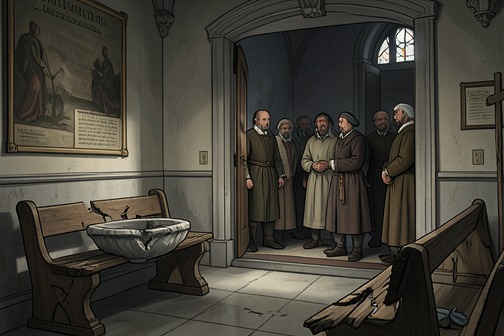
The [Decree of the Roman Curia Recognizing Equal Rights for the Agotes](entity:event-recall-event-agote-9de05a418310) was a papal response to generations of exclusion: it recognized the Agotes as entitled to the same rights as their neighbors and called for discrimination to cease. Its formal intervention exposed the injustice of their treatment, but could not by itself erase the inherited customs and beliefs that kept discrimination alive.
## Origins and Exclusion
The Agotes’ origins were disputed. One widely supported theory held that they had arrived in Navarra across the Pyrenees while fleeing medieval wars, famine, plague, and religious persecution, and that they were Cathars pursued by the [Spanish Inquisition](entity:organization-recall-organization-6c92825ae14b). Other accounts proposed that they were deserters who had contracted leprosy in lazarets in southern France, or a mixture of outcasts brought to serve the feudal lord Pedro de Ursua. Their settlement became concentrated in [Bozate](entity:location-recall-location-602b8eb2793d), near the lord’s fortress in [Arizkun](entity:location-recall-location-arizkun-a4d48437b956).
Whatever their origins, the Agotes remained segregated for centuries. They were treated as an inferior group and barred from living outside Bozate, running businesses, or marrying anyone who was not an Agote. They were pushed into woodworking and leatherworking, trades considered unhealthy, and required to sew an identifying mark onto their clothes. In some accounts, they also had to ring a bell to announce their presence, as if they were lepers.
## Exclusion in the Church
The [Catholic Church](entity:organization-recall-organization-ba391efc867a) reinforced the separation even though the Agotes were Christians who observed Catholic rites. They had a separate baptismal font, and the holy water used for them was discarded. They could be kept at the back of the nave, prevented from approaching the altar, and made to enter through a smaller, separate door. At the church in Arizkun, a grille physically divided them from other worshippers.
These restrictions made religious practice a visible instrument of exclusion: the Agotes could belong to the faith and still be denied equal access to its rites and spaces. The grille was later removed as an expression of the shame that this treatment continued to cause among residents of Arizkun.
## The Decree and Its Limits
The scale and duration of the discrimination eventually prompted a papal edict from Rome recognizing the Agotes’ rights as equal to those of any other neighbor and calling for the discrimination to stop. The decree marked an explicit rejection of their legal and social subordination. Yet, as the account emphasizes, the harm had already been done: custom and belief resisted logic and reason, and the Agotes continued to face discrimination for years after the edict.
## Historical Memory in the Investigation
The decree’s history matters to the present-day investigation because the desecrations at the church in Arizkun were understood as references to the Agotes’ segregation. The damaged baptismal font recalled their exclusion from baptism; a first-row bench recalled the place reserved for nobles and denied to the Agotes; and the altar cloths pointed to a sacred area they had been forbidden to reach. Against that history, the removed grille and the papal decree represent acts of recognition, but neither makes the consequences of centuries of exclusion disappear.
Event 10
Arizkuneko eliza profanazioak
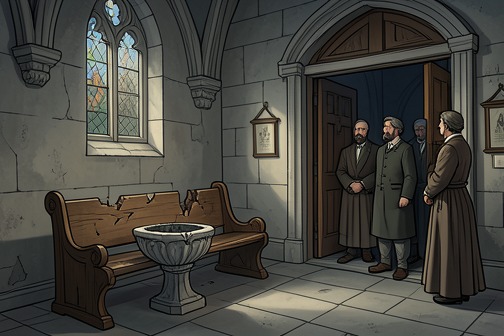
The desecrations at [Arizkun Church](entity:location-recall-location-arizkun-3cb762efd8fa) turn damage to a sacred place into a layered investigation: a smashed baptismal font, burned infant bones, and the possibility that a cemetery had also been violated. As [Amaia Salazar](entity:character-recall-character-amaia-salazar-99849e02d251) and her colleagues pursue the attacks, local belief and the history of Agote segregation illuminate the stakes without establishing who committed the acts or why.
## The Attacks and Their Evidence
The first attack had occurred seventeen days before [Inspector Iriarte](entity:character-recall-character-inspector-iriarte-f7159785492e) questioned the parish priest, Father Lokin. Its most clearly identified damage was the destruction of the baptismal font. When investigators later inspected the sacristy, the elderly, severely deaf chapel attendant showed them the font broken into two pieces and a bench whose splintered wood bore the marks of damage. His repeated signs of the cross and his tears as he looked at the font made the injury to the church tangible: this was not merely a damaged object to him, but an affront to the place and its rites.
The investigation also brought burned infant bones into the case. [Jonan Etxaide](entity:character-recall-character-jonan-etxaide-e04928c45e0f) identified them as a mairu-beso, an object whose traditional status depended on its origin: it had to come from an infant who died unbaptized. He explained the belief that such bones, carried like torches, could produce narcotic smoke and put a household or even an entire village to sleep while their bearers committed nocturnal misdeeds. In light of that identification, [Iriarte](entity:character-recall-character-iriarte-888adecf0207) observed that the case involved the desecration of both a church and a cemetery. Etxaide’s guarded reply—that this was so in the best case—left open the possibility that the implications were worse, without spelling out what further harm might have occurred.
## Folklore and the Boundary of the Sacred
The mairu-beso belief tied the object’s supposed power to two conditions: the child had not been baptized, and the child had died in infancy, as a fetus, stillborn baby, or during the first months of life. The explanation given to Amaia ruled out an adult’s arm. In the tradition described, baptism marked belonging to a religious and social community; the word mairu was associated with a derogatory name for Muslims and meant non-Christian. The object therefore joined the vulnerability of an infant to the boundary between Christian inclusion and exclusion.
The account extended beyond the bone used in a desecration. Unbaptized dead infants were believed to remain between worlds, unable to enter heaven or hell or return to the limbo from which they had come. They might instead stay near their parents’ home as protective presences. Some families, according to the explanation, kept the child’s cradle or set a place and food at the table; they avoided passing the child’s clothes or name to a new sibling, lest the dead child reclaim what belonged to it. These domestic customs gave the mairu-beso tradition an intimate dimension: the same child associated with a frightening magical implement could also be imagined as a welcome, protective companion in the home.
## The Agotes and the Church’s Past
During a roadside conversation, Etxaide set the investigation against competing accounts of the Agotes’ medieval origins. Historians variously connected them to persecuted Cathars, Gothic deserters who contracted leprosy in French lazarets, or a mixture of outcasts brought to serve the local feudal lord, Pedro de Ursua. Their settlement was concentrated in [Bozate](entity:location-recall-location-602b8eb2793d), and the ruined palace-fortress of the Ursua family remained in [Arizkun](entity:location-recall-location-arizkun-a4d48437b956). The explanations differed, but each placed the group’s history in the landscape around the church.
For centuries, Etxaide explained, the Agotes had been prevented from integrating into wider society. They could not live outside Bozate, run businesses, or marry people who were not Agotes. They were pushed toward woodworking and leatherworking, trades considered unclean, and required to wear a distinguishing mark sewn into their clothes; they were also made to ring a bell to announce themselves, as if they were lepers. The Church’s treatment reinforced that exclusion even though the Agotes were Christians who observed Catholic rites. They were assigned a separate baptismal font, and holy water used for them was discarded; they could be kept from the altar, directed to the back of the nave, and made to enter through a smaller, separate door.
At Arizkun, a grille had once separated Agote worshippers from the other faithful. It was later removed as a rejection of the deep shame that this history still caused among the town’s residents. Etxaide connected that past to Father Sarasola’s proposed historical explanation for the contemporary desecrations, but Amaia’s response exposed the distinction between a possible context and a demonstrated motive. The discussion supplied a history of religious exclusion; it did not prove that the attacks were committed in its name.
## Investigation and Unresolved Meaning
The evidence prompted practical work as well as historical inquiry. While forensic reports on the mairu-beso remained outstanding, a patrol was stationed permanently outside the church, and no further incident had occurred by the time Amaia discussed the investigation with Iriarte. She recommended that he and [Zabalza](entity:character-recall-character-zabalza-12fb8d3243c0) question the catechists one by one at their homes, since they might remember something the priest had missed or chosen not to mention. The suggestion broadened the inquiry beyond the parish priest without treating his account as conclusive.
The series also left a human record of damage. Father Lokin’s visible grief over the split font contrasted with the investigators’ need to document it as evidence, while the burned bones expanded the case from vandalism to possible desecration of the dead. The church’s past exclusion of the Agotes gave the attacks an unusually charged historical setting, and the mairu-beso belief supplied a second, folkloric frame. Neither frame, on the available evidence, resolves the perpetrators’ identity or purpose; the investigation remains suspended between physical damage, inherited memory, and a tradition that makes the infant remains signify more than their material form.
Event 11
Profanación de la iglesia de Arizkun y hallazgo del mairu-beso
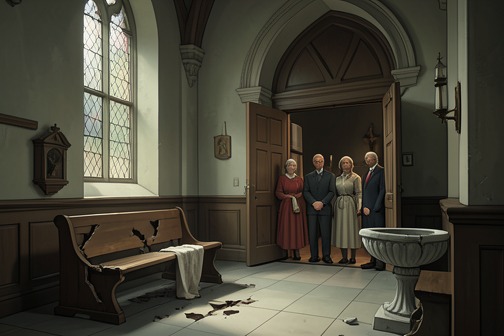
The desecration of [Arizkun Church](entity:location-recall-location-arizkun-3cb762efd8fa) and discovery of the [Mairu-beso](entity:concept-recall-concept-mairu-beso-ea65b13695b8) begin as a criminal investigation into violated sacred ground, but the burned infant bones found there acquire a far more intimate significance when DNA testing connects them to [Amaia Salazar](entity:character-recall-character-amaia-salazar-99849e02d251). The find joins local belief, the history of religious exclusion, forensic uncertainty, and a family secret that had been hidden for decades.
## The Find and Its Forensic Meaning
The small bones had been burned at one end. [Jonan Etxaide](entity:character-recall-character-jonan-etxaide-e04928c45e0f) recognized them as a Mairu-beso, an infant bone believed to have particular powers if it came from a child who died before baptism. In older accounts, such a bone could protect its bearer; its smoke was also said to put the inhabitants of a house or even a whole village to sleep while the bearers carried out their misdeeds. The discovery therefore suggested more than a single desecrated church: investigators feared that a cemetery might have been violated as well.
The scientific examination established that the remains belonged to a boy at around nine months of prenatal development or about one month after birth. Although burned at one end, the bones were sufficiently preserved for testing. Doctor San Martín dated them to approximately 150 years earlier, with a margin of error of five years. That age appeared to fit the traditional account of a Mairu-beso, but the scientific result would soon unsettle the apparent distance between the find and the present.
The discovery also sat alongside a separate forensic question about cut forearms in the investigation. Doctor San Martín described a clean, post-mortem cut made with a toothed implement, possibly resembling a powered cutting tool, and noted a resemblance to the injury in the Johana Márquez case. Comparisons of photographs showed similar cuts on adult forearms, made by a right-handed person with comparable force and confidence. But the photographs could not establish that the same implement had been used, determine the bones’ age, or distinguish surgical amputation from grave desecration. Without the bone samples and the suspected tool, resemblance remained a lead, not proof that the cases shared an instrument or origin.
## Local Belief and Historical Exclusion
The Mairu-beso’s supposed power depended on specific conditions in folk belief: the child had to be very young and unbaptized. San Martín explained that the category included a fetus, a miscarried child, or an infant who died at birth or in the first months of life. The belief drew force from the child’s imagined passage between worlds. In some traditions, a dead unbaptized child remained a protective presence in the family home; families might preserve its cradle, set a place for it at the table, or leave it food. The custom gave domestic form to grief, while also making the dead child’s continued presence subject to rules of respect and remembrance.
Jonan’s account of the Agotes supplied a different historical context for the church desecrations. Their origins were disputed: they might have been religious refugees, including Cathars; descendants of Gothic deserters who contracted leprosy; or a mixed population of outcasts brought to serve a local lord. They settled largely in [Bozate](entity:location-recall-location-602b8eb2793d) and, for centuries, were barred from living elsewhere, running businesses, or marrying outside their group. They were restricted to trades associated with supposedly unclean work and marked by a badge on their clothing; in some accounts they also had to ring a bell to announce their presence.
Although the Agotes were Christians who observed Catholic rites, church practice reinforced their exclusion. They could be assigned a separate baptismal font, denied access to the altar, confined to the rear of the nave, and made to enter through a smaller door. At [Arizkun](entity:location-recall-location-arizkun-a4d48437b956), a grille once separated them from other worshippers; its removal reflected the shame that this history continued to cause among local residents. That history makes the church a charged setting for the desecrations, but the evidence does not establish it as their direct cause.
## The DNA Match and the Family Secret
The laboratory result changed the case’s scale. Because the bones were well preserved inside, a routine DNA check produced a match: a 25 percent correspondence with Amaia. The result was repeated three times. After the first tests at Nasertic, samples were sent to laboratories in Zaragoza and San Sebastián, which returned the same finding. The investigators concluded that the remains belonged to one of her relatives, described as an ancestor in the fourth or fifth degree. Amaia’s immediate response was to question how a newborn from remains estimated to be roughly 150 years old could appear in a modern DNA database; the match was with a relative, not the infant’s own entry.
Later searches of family records brought the discovery closer to home. A birth register showed that [Rosario Iturzaeta](entity:character-recall-character-rosario-iturzaeta-9b8b4d755062) had had three deliveries: [Flora](entity:character-recall-character-flora-c1b11a6eb9e1) in 1973, Rosaura in 1975, and, in 1980, a natural twin birth recorded as uncomplicated. The two girls were described as apparently healthy, but neither had a name entered. The record’s plain administrative wording stood in sharp contrast to what Amaia had been told about her family: the document disclosed another sister where family knowledge had contained none.
A separate death certificate recorded the newborn daughter of [Juan Salazar](entity:character-recall-character-juan-salazar-ca36cbfaa13c) and Rosario Iturzaeta as having died of “crib death,” the common term for sudden infant death syndrome. The certificate offered an official cause, but it did not settle what had happened. Family members said they had not known of the child’s birth; they remembered a closed coffin and had not insisted on seeing the infant. Amaia identified contradictions in the account of the death, irregularities in the birth certificate, and the unexplained infant bones as converging reasons for suspicion. Together, they point toward the possibility that the remains belonged to her twin sister, without resolving every circumstance of the child’s birth, death, or burial.
## Consequences and Significance
The find links three kinds of evidence without making them interchangeable. Local tradition explains why an infant bone might be treated as a Mairu-beso; forensic testing establishes the remains’ developmental age and genetic connection to Amaia; family records reveal a twin birth and a death certificate whose account conflicts with the family’s silence. The historical exclusion of the Agotes gives the desecrated church an additional social resonance, but does not explain the DNA match or prove who disturbed the bones.
For Amaia, the investigation becomes an inquiry into the missing place in her own family as well as the desecration of a church. A bone initially approached as an archaeological or ritual object becomes evidence of an unacknowledged sibling. The mystery is not fully closed by the laboratory results: they establish kinship, while the records and recollections expose concealment and contradiction. The Mairu-beso thus stands at the boundary between communal belief and verifiable evidence, and between a publicly investigated crime and a private history that the family had left untold.
Event 12
La consulta del tarot de Amaia y Engrasi
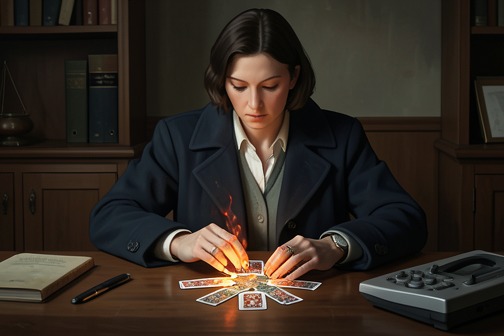
The tarot consultation between [Amaia Salazar](entity:character-recall-character-amaia-salazar-99849e02d251) and [Engrasi](entity:character-recall-character-engrasi-a3e51d66f12b) turns a search for guidance into a warning that reaches from Amaia’s past into her present investigation: an enemy has appeared, is coming for her family, and wants her bones. The cards repeat a reading [Ros](entity:character-recall-character-ros-e213120929a4) made a year earlier, and the encounter ends with one of them burning Amaia’s fingers. Whether treated as divination or an inexplicable physical event, the scene binds memory, family danger, and the investigation in a single object: the deck.
## The Deck and the Question
Amaia takes the small parcel of black silk from behind the glass doors of a cabinet. The object has been waiting there, wrapped and knotted; when she opens it and lifts the cards, they feel warm, almost alive. She hesitates, then shuffles them while turning over the evidence, the lines of her investigation, and the hypotheses she has only begun to form. Her question to Engrasi is what she needs to know. The consultation is thus not detached from police work: Amaia brings the unfinished case to the cards, hoping for a direction that the available evidence has not yet supplied.
Engrasi tells her to shuffle and lays the cards in a cross. Amaia accepts a shortened version of the procedure she knew as a child, taking from the top of the deck. The familiar handling awakens memories of the cards sliding through her young fingers, their distinctive smell, and the serious ceremony Engrasi had taught her for turning them over. In those childhood readings, Amaia felt she knew what each card concealed before it was revealed; once the cards were turned, their relations seemed to draw a route in her mind. Here, that old confidence returns alongside unease. As Engrasi reveals the cards, Amaia recognizes them one by one.
## A Reading Repeated
The spread is not merely reminiscent of the past. Its images match the Marseille tarot reading Ros gave Amaia a year earlier, as if the intervening year had disappeared. The repetition unsettles Amaia because the likeness extends card by card and carries the same dark message. Engrasi turns another card, and the skeleton depicted on it looks up from its empty sockets. The image makes the warning concrete: what follows is not a general forecast but a threat expressed through bones.
Engrasi tells Amaia that another, much more dangerous element has entered the game. It is her enemy; it is coming for her and her family, has already appeared, and will continue to draw her attention until she agrees to play. Amaia asks what it wants from them. Engrasi’s answer is that it wants Amaia’s bones. The words echo the warning Ros delivered in the earlier reading, making the present consultation a return of that earlier scene as well as a disclosure of immediate danger. Yet the warning gives no name to the enemy and no explanation of its purpose beyond the threat itself. The reading raises the stakes without resolving the mystery.
## Anger, the Missing Card, and the Burn
Amaia reacts with fury. Trembling, she gathers the cards into a pack and hurls them over an armchair toward the mantelpiece. They strike it and fall in a loose scatter before the hearth. For a moment she stays still, looking at the few face-up cards whose bright colors attract her even as she feels repulsion and anger. She reproaches herself for falling into the old trap of trying to get ahead of fate. Engrasi watches her; when Amaia looks back, she thinks her aunt appears afraid. Amaia apologizes and begins collecting the cards.
She counts them beside the fire to make sure the deck is complete: fifty-six minor arcana and, she believes, twenty-two major arcana. Her count finds only twenty-one major cards. The missing card is standing on its edge against the inner wall of the fireplace. The fire has died down enough that the card does not seem in danger of burning, so Amaia uses the fireplace tongs to lift it out and places it face down on the floor. When she picks it up to return it to the deck, pain shoots through her arm and across her chest. The sudden pain makes her fear that she is having a heart attack.
The source of the pain proves to be much smaller and stranger than she first fears. Amaia realizes it is concentrated at the tips of her thumb and index finger, where she is still holding the card. She carefully uses her other hand to draw it away; some skin comes off with it and remains on the glossy cover, leaving two distinct marks. The pain stops at once. The card lies face up between her legs, and Amaia does not dare touch it again. She cannot reconcile the severe burn with an ordinary piece of cardboard. After holding her hand under cold water, she finds the skin apparently in good condition, with only a faint tingling in her fingertips.
## Aftermath and Significance
Engrasi cries as she leans over Amaia, then gives her a towel and insists on drying and examining her fingers. The consultation’s closing image is therefore not a solution to the investigation but a small act of care after an experience neither woman has explained. The cards have moved from a wrapped object to an instrument of recollection, then to a scattered deck and the apparent source of a burn. Their physical handling makes the threat difficult for Amaia to dismiss, while the repeated spread connects it to Ros’s earlier warning. The encounter leaves the enemy unidentified, but makes the danger intimate: it concerns Amaia herself, her family, and the bones named by the reading.
Event 13
Segundo ataque contra la iglesia de Arizkun
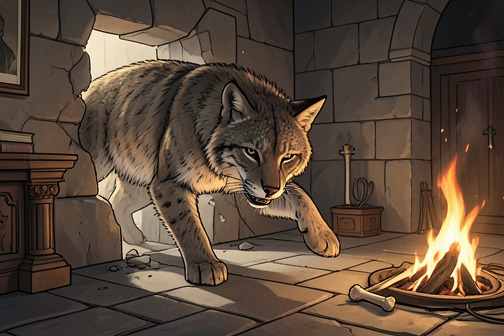
The second attack on [Arizkun Church](entity:location-recall-location-arizkun-3cb762efd8fa) turns a desecration into a calculated intrusion: a Bobcat breaks through the wall at the former Agotes’ entrance, and a small, unburned arm bone is left on the altar. The assault also redirects the police patrol with a deliberately minor fire at [Palacio de Ursua](entity:location-recall-location-palacio-de-ursua-3358a9507ec7). When [Amaia Salazar](entity:character-recall-character-amaia-salazar-99849e02d251) arrives, the bone’s unusual preservation complicates the pattern of the earlier remains and brings the possibility of a personal connection close without resolving it.
## An attack interrupts the investigation
The news reaches Amaia during a long night in the laboratory. While a PCR run continues, she is reviewing the case and considering the possibility that the samples contain evidence of lives taken by the two offenders she understands as an inducer and an obedient instrument of violence. The machine’s signal coincides with an incoming message on [Jonan Etxaide](entity:character-recall-character-jonan-etxaide-e04928c45e0f)’s phone and a call to hers. [Detective Iriarte](entity:character-recall-character-iriarte-d7e5881b702c) reports another attack on Arizkun Church.
Amaia immediately asks whether anything has been left behind. Detective Iriarte confirms that the attackers have left another small arm bone, but says it differs somewhat from the earlier remains and has not been burned. His choice of words—diminishing the bone to a little arm—registers with Amaia because he has young children. The report therefore carries both forensic information and the human scale of what the evidence represents.
Amaia instructs Detective Iriarte to begin the full procedure, notify Doctor San Martín, preserve the scene, and keep everyone outside the perimeter until she arrives. She expects the drive to take more than two hours. Rather than treating the call as a reason to rush blindly, she asks for the scene to remain untouched while she makes her way there.
## The breach and the diversion
The attack took place at about three in the morning. Nearby residents heard the crash of a Bobcat striking the church wall and looked outside, but saw no one. When police arrived, they found a breach in the wall and the remains inside, on the altar. The attack was thus both an act of forced entry and a staged discovery within the church’s sacred interior.
The attackers chose their point of entry with historical precision. The Bobcat was driven into the section where the Agotes’ door had once been—the entrance they had been required to use, later sealed off. The wall there was brick, and the machine’s metal tines punched through it. Amaia notes that breaking through the church wall must have taken considerable effort; Detective Iriarte explains why this particular section made the assault possible. The old division embodied in the building’s architecture becomes the route through which the new violation is made.
The church patrol was absent for a reason. Fifteen minutes before the collision, an emergency call reported a fire at Palacio de Ursua, and the patrol was sent there because it was the nearest unit. The fire proved slight: gasoline had been poured on the palace’s wooden entrance door, which caught readily, and officers put it out with the extinguishers in their vehicle. The diversion’s modest scale is part of its effectiveness: it drew the patrol away without requiring a large blaze or a prolonged response.
The palace, like the church, is connected to the history of the Agotes. One theory holds that the lord of Ursua brought them to the area as laborers and servants. The two locations therefore link the immediate tactics of the attack to a longer history of exclusion: the attackers exploit the church’s sealed entrance and use a fire at another site associated with the same people to clear the way.
## The remains on the altar
Doctor San Martín is waiting inside when Amaia arrives. A small bundle, covered by a metallic blanket, lies on the altar. He uncovers the bones while Detective Iriarte and the doctor watch Amaia as closely as they watch the remains. She makes an effort to remain impassive and studies the evidence before them.
The new remains differ materially from the earlier ones. Their ends have not been burned, their joint is clearly distinguishable, and their color is much whiter. Doctor San Martín explains that they have not been in contact with soil; instead, they were kept inside a well-sealed coffin in conditions of very low humidity. Even the finger phalanges are perfectly preserved. These are not merely another set of remains placed in the church: their condition points to a different history of storage and burial.
Amaia looks at the bones for several more seconds, aware that she may have a connection to them. She covers them again with particular care, almost as if wrapping them in a blanket. The gesture contrasts with the force of the machine that brought them into view: the attack treats the remains as an object of desecration, while Amaia’s response is protective, though she does not yet establish what the possible connection means.
## Investigation and significance
The attack’s details give the police several distinct lines to preserve and examine: the point of impact at the former Agotes’ entrance, the Bobcat and its tines, the timing of the false fire call, the small amount of gasoline used at Palacio de Ursua, and the bone’s markedly different condition. Amaia’s insistence on keeping people away from the scene protects that evidence as the investigation begins; Doctor San Martín’s examination distinguishes the new remains from those found previously.
The event also tightens the relation between historical exclusion and present violence without making the two identical. The attackers use a door once imposed on the Agotes as their means of entry, while the remains on the altar recall the church’s earlier desecration. The white, carefully preserved bone stands in contrast to the burned remains and to the destructive breach surrounding it. Its source remains uncertain in this scene, but Amaia’s response makes clear that the investigation has become personally charged as well as forensic.
Event 14
Hallazgo de los enterramientos del itxusuria de Juanitaenea
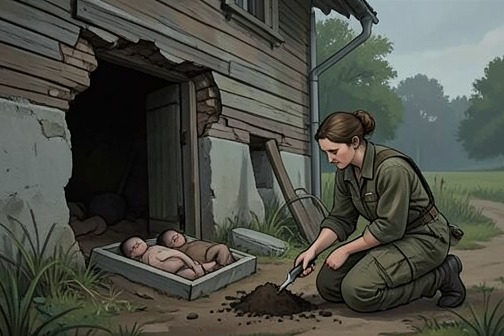
The discovery of the itxusuria burials at [Juanitaenea](entity:location-recall-location-juanitaenea-53fbc9a22718) turns a search for disturbed ground into a confrontation with [Amaia Salazar](entity:character-recall-character-amaia-salazar-99849e02d251)’s family history. Beneath the house’s eaves, she finds the traditional resting place of infants who died before baptism, including relatives whose graves have been disturbed. The scene gives physical form to a local burial custom, while raising the possibility that the person desecrating the church at [Arizkun](entity:location-recall-location-arizkun-a4d48437b956) has also been robbing family graves.
## The discovery at Juanitaenea
The alarm begins when the architect, Manolo Azpiroz, notices that earth around Juanitaenea has been dug up in several places. He had cautioned [James](entity:character-recall-character-james-b40e84036a54) against starting garden work because construction materials would damage the grounds; James insists that nobody in the household has been digging. After Azpiroz reports the disturbed soil, James calls Amaia. He has already found something in one of the holes and thinks it may be bones.
Amaia leaves the station with her field kit and brings [Iriarte](entity:character-recall-character-iriarte-888adecf0207) to the house. On the drive, she recognizes what she should have considered earlier: in [Baztán](entity:location-recall-location-bazt-n-b5321a4399fc), unbaptized children were not necessarily buried by a crossroads or beside a cemetery wall. Families had a designated place for them at home. The itxusuria, or corridor of souls, was the strip of ground beneath the eaves where rain dripped from the roof, marking a boundary between inside and outside. Amaia realizes that her own family, like other families in the valley, may have buried its dead infants there.
James waits by the vegetable garden with [Ibai](entity:character-recall-character-ibai-8322a92bd103) in his pram. Distressed and unsure whether the remains are human, he is also offended by the sudden arrival of what he sees as the sordid. Amaia kisses Ibai’s hand while he sleeps, then tells James to take the child inside and say nothing to [Ros](entity:character-recall-character-ros-e213120929a4) or her aunt until the remains are identified. She turns to the investigation with Iriarte.
## What the ground reveals
In light rain, Amaia and Iriarte walk the perimeter, where mounds of newly turned earth are visible around the house. At the nearest one, Amaia points out a boot print whose edges are already softening in the rain. Iriarte shelters it with his umbrella and photographs it with a reference marker. They document the disturbed ground before Amaia begins to sift through the wet soil by hand.
In one opening, she uncovers a skull no larger than a small apple. Another hole has been hastily refilled but contains nothing. At the corner where the roof’s eaves meet the ground, dark infant bones protrude from the mud, their color at first making them easy to mistake for roots. Looking over the rear of the house, Amaia counts at least nine excavations on that side and as many on the other. The trail is written into the ground itself: centuries of dripping water have formed a shallow line beneath the eaves, and whoever opened the graves could follow it.
Further inspection reveals three more skeletons in two holes. The remains are broken and badly deteriorated, but one burial contains a frayed fiber. Amaia recognizes it as part of a cradle blanket. Beneath a waxed cloth, she finds the small bundle a mother had wrapped around her baby, as if covering the child for sleep could still protect it in the earth. She is shaken by the care preserved in the cloth and by the violation that has torn it open. She separates the fabric where it was ripped, sees the small bones intact beneath it, then covers the skeleton with the blanket, closes the bundle, and puts earth back over it.
## Family custom and a police decision
Amaia explains to Iriarte that the burials form an itxusuria, the traditional family cemetery of Baztán. The infants were members of her family. Their mothers had placed them at home as sentinels to guard the house. The graves are not merely evidence of an old custom to her: they are the remains of generations of private mourning, and the family’s way of keeping its dead close.
Calling San Martín would bring a forensic team to excavate all the small bodies. Amaia fears that the discovery would attract reporters, photographs, and a public spectacle. She also suspects that the person behind the desecration at the church in Arizkun—not the young man already associated with the church episode—has been plundering these graves. In her view, announcing the discovery could warn that person away. She asks Iriarte to let the family cemetery remain undisturbed. He agrees that he would not allow anyone to excavate his own family’s cemetery. Their decision protects the site for the moment, even as it constrains the investigation.
## The cost of recognition
The blanket makes the custom intimate rather than abstract. Kneeling in wet earth, Amaia imagines the woman who laid the child down at night and covered it carefully, perhaps an ancestor of her own. She cannot be certain whether the mother was her great-grandmother or an earlier forebear, but the uncertainty does not lessen the recognition: the bundle carries a mother’s act of care across generations. Amaia’s tears fall on the bones as she restores the covering and replaces the soil.
When she and Iriarte step back, the rain is already smoothing the small mounds. The opened graves recall the grief of generations of women in her family, but the scene also triggers a present fear: Amaia imagines having to lay Ibai in the mud. Her breath leaves her and her strength gives way; Iriarte asks whether she is all right. The discovery has exposed not only the family’s burial ground and its recent violation, but also how directly the inherited history of infant death touches Amaia’s own life as a mother.
Event 15
Nacimiento de Amaia y su hermana gemela
The birth of [Amaia Salazar](entity:character-recall-character-amaia-salazar-99849e02d251) and her twin sister is first presented as a frightened father’s vigil and a reassuring announcement, then recast as a family secret. On June 23, 1980, [Rosario Iturzaeta](entity:character-recall-character-rosario-iturzaeta-9b8b4d755062) delivered two girls at home in [Elizondo](entity:location-recall-location-elizondo-4e0690247b99). [Juan Salazar](entity:character-recall-character-juan-salazar-ca36cbfaa13c) was told that both were healthy, but later records identify the death of a newborn daughter, while concealed information and unexplained remains make the circumstances of the birth and death uncertain.
## A concealed high-risk pregnancy
The scene opens during a storm over Elizondo. [Juan](entity:character-recall-character-juan-08eb0a988bb3) has retreated to the bathroom, where he kneels by candlelight to pray, ashamed to be seen in such distress. More than three hours earlier, at about nine in the evening, [Rosario](entity:character-recall-character-rosario-381ff2a9040d) had asked him to take their daughters to her mother’s house. The girls lingered to watch older boys light bonfires in the streets. Rosario had called Doctor Juan Hidalgo, but Juan has heard no reassuring update; the house’s power has failed, and its ominous silence follows the screams from the room where she is giving birth.
The delivery takes place at home by Rosario’s choice. Doctor Juan Hidalgo had recommended hospital care, and the pregnancy carried the added risk of twins, but Rosario would not go to hospital or even have an ultrasound. She intended to give birth at home as she had during her earlier pregnancies. She had also kept the twin pregnancy from her family, so the arrival of two babies was concealed before either child was born. The combination of a known medical risk, refused examination, and deliberate secrecy makes the birth more than a private domestic event: from the outset, the people who might have shared responsibility or witnessed what happened were kept at a distance.
## The announcement in the candlelit house
When Doctor Juan Hidalgo calls through the bathroom door, Juan quickly washes his face and comes out carrying a towel. He asks first whether Rosario is all right. The doctor tells him that she is well and that both babies are well: two strong, healthy girls. Juan takes the doctor’s disinfectant-scented hand, smiles, and asks to see them. He is told to wait while [Fina Hidalgo](entity:character-recall-character-fina-hidalgo-0b74a6a75163) finishes cleaning and preparing Rosario. Still smiling, Juan jokes that he seems to know how to make only girls and offers the doctor a drink.
The scene gives Juan a moment of apparent relief, but it does not show him meeting the newborns. His request is postponed while Fina remains with Rosario, and the reassurance that the girls are healthy reaches him through the doctor rather than through his own sight of them. Read alongside the later records, that gap acquires weight: the announcement promises a simple, happy outcome, while the family’s knowledge of what followed proves incomplete.
## Records that revise the birth
Years later, Amaia examines Rosario’s obstetric file. It lists an uncomplicated natural birth of a seemingly healthy girl, [Flora Salazar](entity:character-recall-character-flora-salazar-26a86171e8e0), in 1973; another uncomplicated natural birth of a seemingly healthy girl, [Rosaura Salazar](entity:character-recall-character-rosaura-salazar-2808d661bd49), in 1975; and an uncomplicated twin birth in 1980. The two babies are recorded as seemingly healthy, but, unlike the earlier entries, no names are given. The archive confirms that there were twins, while its omissions leave the identities and subsequent fates of the babies obscure.
A separate death certificate deepens the contradiction. It identifies a newborn daughter of Juan Salazar and Rosario Iturzaeta and gives the cause as crib death, the common term for sudden infant death syndrome. The certificate does not erase the doctor’s announcement that two healthy girls had been born; instead, the two pieces of information sit uneasily together. The record’s stated cause also prompted suspicion that the child may have been unwell, but it does not, by itself, settle what happened. Amaia’s inquiry is further complicated by irregularities in the birth certificate and by the unusual discovery of skeletal remains thought to belong to the dead twin.
## A family secret and an unresolved death
The later family account confirms how thoroughly the birth was concealed: Amaia and her sisters had not known that Rosario gave birth to another child. An uncle suggests that the family’s relationship with Rosario changed after the girl died. Relatives say they saw a burial, but the coffin was closed, and they did not insist on seeing the baby. Their testimony can establish what they believed they had witnessed, not the identity or condition of the body inside.
The unease surrounding the remains also intersects with the local belief in the [Mairu-beso](entity:concept-recall-concept-mairu-beso-ea65b13695b8), which was understood to derive its supposed power from the bones of an infant who died unbaptized. That belief supplies cultural context for why infant remains could carry significance, but it does not prove the twin’s fate or explain the documentary irregularities. The event therefore remains suspended between a birth announced as uncomplicated and healthy, a certificate recording a newborn death, relatives excluded from the pregnancy, and evidence that raises further questions. Its decisive consequence is to turn Amaia’s own birth into an investigation of the sister whose existence her family had been made to forget.
Event 16
El parto gemelar de Rosario y la muerte encubierta de una recién nacida
The birth of [Rosario Iturzaeta](entity:character-recall-character-rosario-iturzaeta-9b8b4d755062)’s twin daughters in June 1980 is both a family tragedy and the origin of a concealed history that reshapes [Amaia Salazar](entity:character-recall-character-amaia-salazar-99849e02d251)’s understanding of her mother and her own birth. One baby is found dead; [Rosario](entity:character-recall-character-rosario-381ff2a9040d) is interrupted while pressing a cushion against the face of the other, who survives. The death is attributed to cot death, but the account that reaches the next generation is full of omissions, contradictions, and uncertain evidence.
## Background and the hidden birth
The family record later consulted by Amaia lists earlier uncomplicated births: [Flora](entity:character-recall-character-flora-c1b11a6eb9e1) in 1973 and Rosaura in 1975. For 1980, it records a natural twin birth without complications, describing both girls as apparently healthy but giving neither a name. That bland entry sits uneasily beside the family’s silence: Amaia and her sisters were never told that another child had been born, and the twins’ records do not explain what became of either baby.
The documentary trail offers a partial, not definitive, account. A death certificate identifies a newborn daughter of [Juan Salazar](entity:character-recall-character-juan-salazar-ca36cbfaa13c) and Rosario Iturzaeta and gives cot death as the cause. The term was commonly used for sudden infant death syndrome, but the certificate does not resolve the circumstances Amaia later investigates. The family also remembers that the dead child’s coffin was closed; relatives attended the burial without seeing the body. What looks like a settled entry in a register therefore conceals a death whose cause, handling, and final resting place remain in question.
## The birth and the confrontation
On June 23, Rosario stands over the twins after giving birth. When [Juan](entity:character-recall-character-juan-08eb0a988bb3) enters the bedroom, she is pressing a small satin cushion against the face of one baby. He cries out and knocks her away. The infant immediately begins to cry, while Rosario, weakened by labor, lies on the bed without speaking or protesting. The doctor checks the child and confirms that she is alive. Juan then turns to the other cradle: the second girl is motionless, and he realizes she is already dead.
The two cradles establish a stark contrast, but they do not supply a complete explanation. Juan has directly witnessed Rosario holding the cushion over the surviving baby’s face, yet the death of the other twin has a different and unresolved history. The scene records his recognition of the death, not its cause. Neither the birth record nor the later certificate fills that gap.
## A death recast as cot death
In a later scene dated June 23, Juan recalls what he saw and challenges [Fina Hidalgo](entity:character-recall-character-fina-hidalgo-0b74a6a75163)’s attempt to soften it. Fina suggests that Rosario may only have been putting the cushion beneath the baby’s head. Juan insists that it had been over the child’s face. Manuel Hidalgo, who has examined the dead infant, says there are no signs of violence and that apparent asphyxia could be cot death, which commonly occurs in newborns during their first hours. Fina invokes the risk of involving the police and of destroying both the family and her brother’s career; she also says he failed to treat symptoms he had noticed in Rosario.
The competing accounts are not equivalent. Juan’s testimony describes what he saw; Fina’s explanation recasts that observation, while Manuel’s medical statement leaves room for cot death rather than establishing it as the cause. The decision to use that diagnosis turns uncertainty into an official conclusion. Manuel writes “Sudden infant death syndrome (cot death)” on a death certificate, then vomits after looking again at the dead child’s face, which is bruised and shows redness on the nose consistent with pressure. The certificate records a cause, but the scene makes clear how fragile—and compromised—that conclusion is.
## The child taken away
On the morning of June 24, Juan feeds the surviving baby, whose strength at the bottle gives him a moment of relief. The dead twin remains in a second cradle in the sitting room. Rosario, dressed and prepared to leave, tells him she will go to San Sebastián to arrange the burial, while he stays to care for the girls and attend to the bakery. She refuses his plea to accompany her.
A taxi from [Pamplona](entity:location-recall-location-pamplona-af6d7e105eb5) is already waiting. Rosario lifts the dead child and wraps her carefully in a fine shawl, holding her as if she were alive. She says she will return the next day, but Juan turns away rather than watch her leave with the baby. His action leaves him caring for the living child while Rosario takes the dead one out of the household. The burial is thus separated from the family’s view, and the closed coffin later remembered by relatives extends that separation into the public record.
## Discovery and evidentiary limits
Decades afterward, Amaia learns that the 1980 record was for a twin birth and that a newborn daughter was officially registered as having died of cot death. She also discovers that her mother concealed the birth from the family, that the birth documentation contains irregularities, and that the circumstances of the death conflict with the evidence surrounding Rosario’s actions. Her relatives’ recollection of a closed coffin cannot establish what was inside it or where Rosario ultimately buried the child.
The investigation also brings in bones recovered in strange circumstances. Forensic examination dates them to approximately 150 years earlier and identifies them as belonging to a newborn; routine DNA testing finds a 25 percent match with Amaia, a result confirmed by testing at multiple laboratories. That match creates a striking family connection, but it does not, by itself, identify the remains as the twin: the reported age and sex of the bones do not neatly fit the identity Amaia is trying to establish. The evidence makes the family history more suspicious without resolving every contradiction.
The event’s force lies in the collision between witnessed action and official explanation. Juan sees one baby saved from the cushion and another already dead; a medical certificate turns the latter’s death into cot death; Rosario carries the body away; and the family’s memory preserves little beyond a closed coffin and a concealed birth. When Amaia reconstructs the episode, the gaps are not incidental: they are the means by which a twin’s existence and death were hidden, and the reason the past remains only partly recoverable.